

Understanding Your Child’s Temperament: Looking Beyond Behaviour
One of the most common questions I hear from parents is:
“Why does my child react this way?”
Perhaps one child happily walks into a new situation while another clings tightly to your leg. One child seems driven and determined, while another is content to go with the flow. One child wears their heart on their sleeve, while another keeps their feelings tucked away.
As parents, it can be easy to focus on behaviour. However, beneath every behaviour is a unique child with their own personality, emotional needs, and way of experiencing the world.
This is where understanding temperament can be incredibly helpful.
What Is Temperament?
Temperament refers to the inborn characteristics that influence how a child experiences and responds to the world around them. It affects things such as emotional reactions, energy levels, adaptability, social preferences, and how children cope with stress and change.
Temperament is not something that needs to be fixed or changed. Rather, it provides us with a framework for understanding why children may respond differently to the same situation.
When parents understand their child’s temperament, they are often able to respond with greater empathy, patience, and confidence.
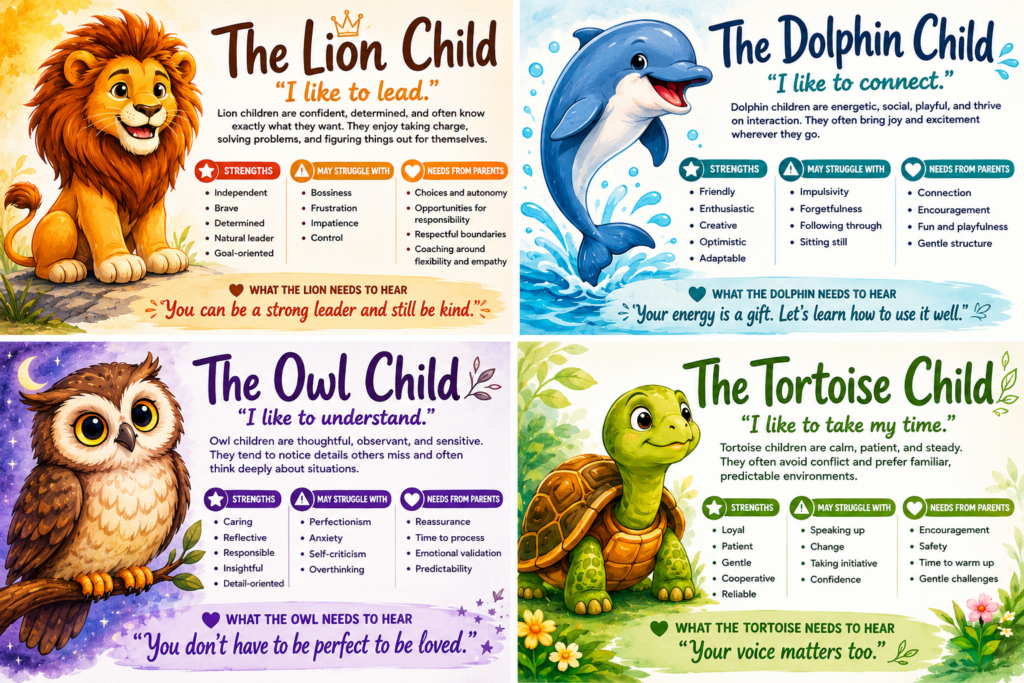
The Social and Enthusiastic Child (The Dolphin)
Some children seem to make friends wherever they go. They are energetic, expressive, curious, and thrive on interaction with others. These children often enjoy being around people and may naturally bring excitement and fun into everyday situations.
While their enthusiasm can be a wonderful strength, they may sometimes struggle with impulse control, sustained attention, or following through with tasks.
These children often benefit from clear routines, gentle structure, and opportunities to connect socially while still learning important skills such as patience and self-regulation.
The Determined and Strong-Willed Child (The Lion)
Other children seem to arrive in the world knowing exactly what they want.
These children are often confident, independent, goal-oriented, and natural leaders. They enjoy taking initiative and are not afraid to express their opinions.
While these qualities can be incredibly valuable, strong-willed children may sometimes struggle with flexibility, frustration, or considering perspectives that differ from their own.
These children often thrive when given opportunities for responsibility, leadership, and problem-solving, while also being guided towards empathy, cooperation, and emotional awareness.
The Sensitive and Thoughtful Child (The Owl)
Some children experience the world deeply.
They may be reflective, detail-oriented, emotionally aware, and sensitive to both their own feelings and the feelings of others. These children often think carefully before acting and may notice things that others miss.
Because they tend to feel things deeply, they may also be more vulnerable to self-criticism, anxiety, or perfectionism.
These children often benefit from reassurance, emotional support, and gentle encouragement to view mistakes as part of learning rather than evidence of failure.
The Calm and Easy-Going Child (The Tortoise)
Then there are children who seem content to quietly observe the world around them.
These children are often patient, cooperative, adaptable, and peace-loving. They may avoid conflict and prefer calm, predictable environments.
Although their easy-going nature is often appreciated by adults, these children can sometimes struggle to express their own needs or take initiative in unfamiliar situations.
They often benefit from encouragement to find their voice, advocate for themselves, and step outside of their comfort zone at their own pace.
There Is No “Best” Temperament
One of the most important things for parents to remember is that there is no ideal temperament.
Every temperament comes with both strengths and challenges.
The confident child may struggle with flexibility. The sensitive child may be vulnerable to self-doubt. The sociable child may struggle with focus. The easy-going child may find it difficult to speak up for themselves.
Our role as parents is not to change who our children are, but to help them understand themselves, develop their strengths, and learn skills that support them in areas they find more challenging.
Parenting the Child You Have
Sometimes parenting becomes difficult because we are trying to parent all children in the same way.
A strategy that works beautifully for one child may completely miss the mark for another.
Understanding temperament reminds us that children have different needs, different ways of communicating, and different ways of experiencing the world.
When we shift from asking, “How do I get my child to behave differently?” to “What might my child need from me right now?”, we often discover new ways of connecting and supporting them.
How Parent Guidance Can Help
Many parents find it helpful to explore their child’s temperament in greater depth, particularly when navigating behavioural challenges, emotional difficulties, sibling differences, or parenting stress.
In parent guidance sessions, we work together to better understand your child’s unique temperament, emotional needs, and developmental stage. By viewing behaviour through a lens of understanding rather than frustration, parents often feel more confident and equipped to respond effectively.
If there is one thing I hope parents understand about temperament, it is this: your child’s temperament is not a problem to solve. It is part of who they are. When we learn to understand and work with our children’s natural tendencies, we create opportunities for deeper connection, greater confidence, and healthier emotional development.
-Inge Alberts